
Updated ,first published
Follow our live coverage of the Nepal floods here.
Warning: This story contains graphic content.
Boys aged as young as 11 and 14 are among the 34 Australian pilgrims reported missing after an avalanche of ice and rock triggered enormous flash floods that devastated parts of Nepal and China on Wednesday, killing at least 160 people and causing widespread damage.
Nepalese officials said 403 people – including 341 foreign nationals – were reported missing. Sunil Sharma, a tourism board spokesperson, said 133 were from India on pilgrimage to Mount Kailash in Tibet, a sacred site for Hindus.
Also missing were 34 from Australia, 47 from the United States, 33 from Britain and 24 from Canada, he said.
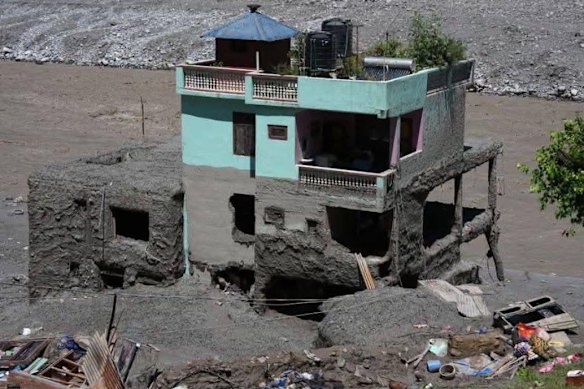
The flood was powerful enough to tear large buildings away from their foundations, rip up bridges and engulf people trying to flee from the disaster.
Fifteen of the 34 missing Australians were on a tour in Nepal with the US-based Himalayan Glacier tourism operator when the catastrophic floods hit, according to Himalayan Glacier founder and chief executive Sagar Pandey.
The Australians on the tour remain unaccounted for, one day after the floods swept through Nepal and China. Two boys in the group, aged 11 and 14, are believed to have been travelling with their parents. The oldest of the missing contingent is a woman aged 64.
The tour operator said in a social media post that it had not been able to make contact with anyone on the ground and that it knew the uncertainty would be distressing for the families of the missing.
“Please know that the government of Nepal and the Nepal Army are actively carrying out search and rescue operations and are making every possible effort to assist those affected,” Himalayan Glacier said.
Sue Badyari, chief executive of Australian tour company World Expeditions, said her local team in Nepal had confirmed all its “clients and staff currently travelling in the country are safe and accounted for”.
Videos posted online show roads and bridges in northern Nepal’s mountainous Rasuwa district being washed away by sudden flooding that struck about 8.30 am (12.30 AEST).
Dramatic surveillance footage from the Rasuwagadhi border point on the boundary of Nepal and China showed a forceful wave of muddy brown water passing downhill and smashing through a multi-storey building as people unsuccessfully tried to run for their lives.
Separate footage showed the flood destroying a bridge in Nuwakot in central Nepal as it pounded buildings on both sides of the river and uprooted trees.
An initial analysis of satellite imagery suggests that a flood occurred in the Lhende River due to a landslide on the Nepal–China border, according to a post on X by Nepal’s National Disaster Risk Reduction and Management Authority.
Initial reports from Nepalese officials suggested that an earthquake could have caused the lower part of a glacier to collapse, triggering the floods. But the US Geological Survey later said that the 4.4-magnitude tremor recorded at the time was caused by glacial rock and ice collapsing onto the valley floor, causing a water avalanche.
How has the Australian government responded?
Confirming the number of Australians missing in the disaster, Prime Minister Anthony Albanese highlighted the difficulties in getting information out of Nepal.
“Nepal, you know, is a developing country. It doesn’t have the resources that an event like that would have in Australia, so information is difficult,” he said, speaking from the Bush Summit in Dubbo on Monday morning.
“Our thoughts are with all those who’ll be concerned about their loved ones today.”
Earlier, Albanese said officials were urgently working with local authorities and tour operators to confirm the welfare of the missing.
“We stand ready to provide consular assistance. Australians in the affected area should follow the advice of local authorities,” he said.
Foreign Minister Penny Wong described the loss of life and destruction caused by flash flooding as “devastating”, while Australia’s Nepal embassy issued a joint statement with the embassies of Finland, France, Norway, Switzerland and Britain expressing “solidarity with the people of Nepal during this difficult time”.
“We encourage all those in affected areas to follow the guidance of local authorities and official safety advisories as the situation continues to evolve,” the statement read.
Wong said the number of 34 Australians reported missing was the minimum and could grow over coming days.
“We are currently deploying further [Department of Foreign Affairs and Trade] personnel, including crisis response experts to the region,” Wong told reporters in Adelaide.
“I’ve asked DFAT to ensure that we do provide the support needed to these posts, particularly our post in Nepal.”
Describing the disaster as an “awful situation”, Wong said she would engage with the Nepalese government and multilateral organisations such as the Red Cross.
Opposition Leader Angus Taylor said in a social media post: “Our thoughts are with all those affected by the devastating flooding in Nepal and Tibet, including the families who have lost loved ones and those still waiting for news.
“We are also thinking of the Australians caught up in this disaster and their families here at home.”
Tour groups Intrepid Travel and G Adventures confirmed that all tourists in their groups and staff in the region were safe.
What is the death toll, and how many people are missing?
Nepalese police said 157 bodies have so far been recovered. Neighbouring China has reported at least three people killed and 265 missing in a community on the Tibetan side of the border.
Thousands of people also live in riverside settlements downstream from the flooding, including along the Bhote Koshi and Trishuli rivers. Nepalese authorities have not estimated the number of people missing and the extent of damage, but said that bridges, schools and hydropower projects have been swept away, The New York Times reported.
Sunil Sharma, a Nepal Tourism Board spokesperson, told the Toronto Star that 133 of the missing tourists were from India on a pilgrimage.
At least 62 missing Nepalese citizens were among hundreds of locals trekking in the Gosaikunda Lake area in Rasuwa, coinciding with the local festival of Janai Purnima on Friday, Sharma added.
Nepal police spokesperson Abi Narayan Kafle told the Associated Press that at least 28 police officials were unaccounted for.
Nine South Koreans working on a hydropower plant are also missing, and 10 others are stranded, South Korea’s Foreign Ministry said late on Wednesday.
Which regions were hit?
The Bhote Koshi River flooded about 9am on Wednesday (1pm AEST), destroying several villages as well as roads and hydropower projects, officials said.
Warnings were issued in several districts urging people to stay away from the banks of the Bhotekoshi, Trishuli and Narayani rivers.
Torrential floods triggered a mudslide that hit Gyirong Port, a major land crossing with neighbouring Tibet, cutting roads, communications, and power links to the area.
Nepal’s security personnel have rescued more than 250 people with an army helicopter, while police and the military continue searching in flood-affected areas, Nepal’s Prime Minister Balendra Shah said in a Facebook post.
“We have asked both India and China to help us with the rescue efforts,” said Sasmit Pokharel, a spokesperson for the Nepali government.
China has deployed at least 574 rescuers to the land crossing, and India says it was coordinating closely with Kathmandu on rescue and relief efforts.
People living in low-lying regions were being moved to safer areas, and those along the river have been advised to remain alert, as authorities warn that a second flood may occur because a blockage remains upstream.
Flood alerts have also been issued in the Indian states of Bihar and Uttar Pradesh, which border Nepal, since several rivers flow down the Himalayas into their plains.
Nepal’s Energy Ministry said the country’s electricity supply had been significantly affected, largely due to the destruction of hydroelectric plants.
Rasuwa, the worst-affected area, witnessed flash floods similar to those in August last year, when a glacial lake in neighbouring Tibet overflowed due to high temperatures in the mountain region. Nine people lost their lives, and critical infrastructure, including a bridge connecting the two countries, was damaged at the time.
Climate experts at the Kathmandu-based International Centre for Integrated Mountain Development said the Lhende Khola River, a tributary of the Bhote Koshi River, experienced its highest-recorded flood on Wednesday.
“The Lhende Khola has flooded twice in 14 months, this time triggered by an ice rock avalanche from a glacier on the Nepal side that blocked the river and released a sudden surge downstream,” said Saswata Sanyal, a disaster risk reduction specialist at the climate research group.
“In a warming Himalaya, early warning is the first line of adaptation,” he added.
The Himalayan region, which spans Nepal and several neighbouring countries, including India, is especially vulnerable to heavy rains, floods, and landslides because it is warming faster than much of the rest of the world due to human-caused climate change.
Research has shown that extreme weather events, including heatwaves, heavy rains and melting glaciers, have become more frequent in the region.
Members of the Kathmandu research group found earlier this year that glaciers across the Hindu Kush Himalaya region are melting at an accelerating rate, with ice loss rates doubling since 2000 primarily due to rising global temperatures and climate change.
Australians in need of emergency consular assistance should contact the Department of Foreign Affairs and Trade’s 24-hour Consular Emergency Centre on 1300 555 135, or +61 2 6261 3305 (if calling from overseas).
With AP, Reuters, Bloomberg, Josefine Ganko
Read more on the Nepal flood disaster:
 Matthew Knott is the foreign affairs and national security correspondent for The Sydney Morning Herald and The Age.Connect via X, Facebook or email.