
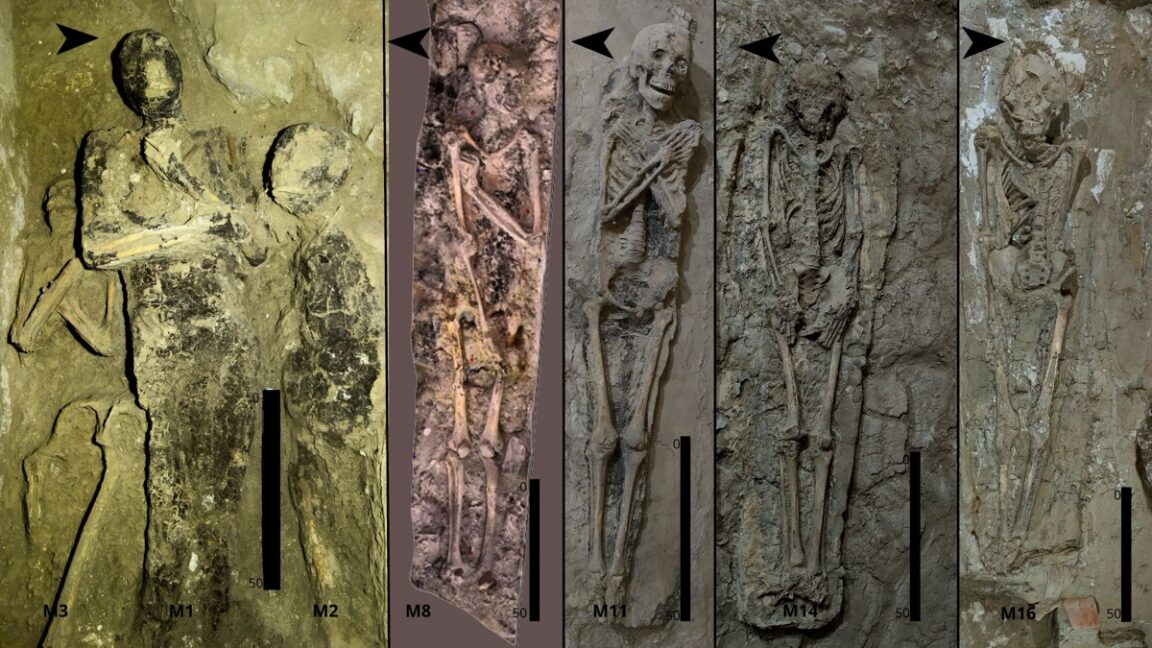
“The earliest individuals buried here appear to have been of high social standing, as they were interred in coffins, with funerary nets and amulets, and with an assemblage containing costly items, such as the contents held in Phoenician amphorae, a large number of which were found alongside them,” said co-author Miguel Ángel Molinero Polo, also from the University of La Laguna. “The bodies buried in vertical superposition did not have coffins but were carefully mummified. They also can be associated with upright jars that point to a specific ritual not found in the earlier phases of the tomb’s use.”
There was also evidence in some chambers of substantial reworking in the form of accumulated silts, sands, gravels, limestone blocks, plaster, ceramics, and other displaced materials—some due to human intervention, some possibly due to flooding. And one chamber—the one with the fragmented remains of four people—may have experienced a fire, since the remains had clearly been damaged by excessive heat (as high as 550° Celsius, or 1,022° F), particularly the crania and lower limbs.
“Overall, [this site] can be understood as a funerary space with an accumulative biography, in which reuse did not simply involve the addition of burials, but the progressive transformation of the organization, materiality, and meaning of the space itself,” the authors concluded. “Rather than acting as a passive container, the chamber can be interpreted as a dynamic mortuary environment where bodies, objects, sediments, and architectural constraints shaped the material construction of funerary continuity over time.”
Frontiers in Environmental Archaeology, 2026. DOI: 10.3389/fearc.2026.1888379 (About DOIs).